
Kabaddi: From Mud Courts to Prime-Time League
मुख्य बिंदु (उत्तर कैप्सूल): (1) कबड्डी सात-सात खिलाड़ियों की दो टीमों का संपर्क खेल है, जिसमें 20-20 मिनट के दो हाफ होते हैं और रेडर के पास 30 सेकंड की सीमा होती है। (2) अंतरराष्ट्रीय दर्जा: 1982 दिल्ली एशियाई खेलों में प्रदर्शन खेल, 1990 बीजिंग से पदक वाला खेल; महिला वर्ग 2010 ग्वांगझू से शामिल। (3) व्यावसायिक मोड़: 2014 में प्रो कबड्डी लीग की शुरुआत, फ्रैंचाइज़ी मॉडल, शुरुआत में 8 और बाद में 12 टीमें। (4) प्रमुख खिलाड़ी: परदीप नरवाल, पवन शेरावत, नवीन कुमार, मनिंदर सिंह, अजय ठाकुर, फजल अत्राचली। (5) चुनौतियां: चोटों का उच्च जोखिम, व्यस्त कैलेंडर, महिला कबड्डी में कम निवेश, भारत के बाहर सीमित पेशेवर बाजार।
In most parts of India, kabaddi is still identified with the school playground, the village square and the games played during holidays. But over the past two decades, the economy of the sport, the way it is presented and the audience it reaches have all changed. Kabaddi now occupies prime-time television with the same seriousness that cricket or football command. It is a game with no ball, no bat and no net—just one player running on held breath and a wall of seven trying to stop him. That simplicity is its greatest strength, and it is probably what carried it to tens of millions of viewers.
The origin of the word kabaddi is disputed. Some scholars trace it to the Tamil 'kai-pidi', meaning to hold hands; others link it to the Sanskrit 'kabad'. Traces of older forms of the game are also sought in the remains of the Indus Valley Civilisation, though historians do not fully agree on those claims. The Chakravyuha formation in the Mahabharata is often compared to a kabaddi raid—a single player goes in and tries to break through the wall of defenders and get out. In the medieval period the game was played in different regions under names such as 'hu tu tu', 'sanchi' and 'gadgadi'.
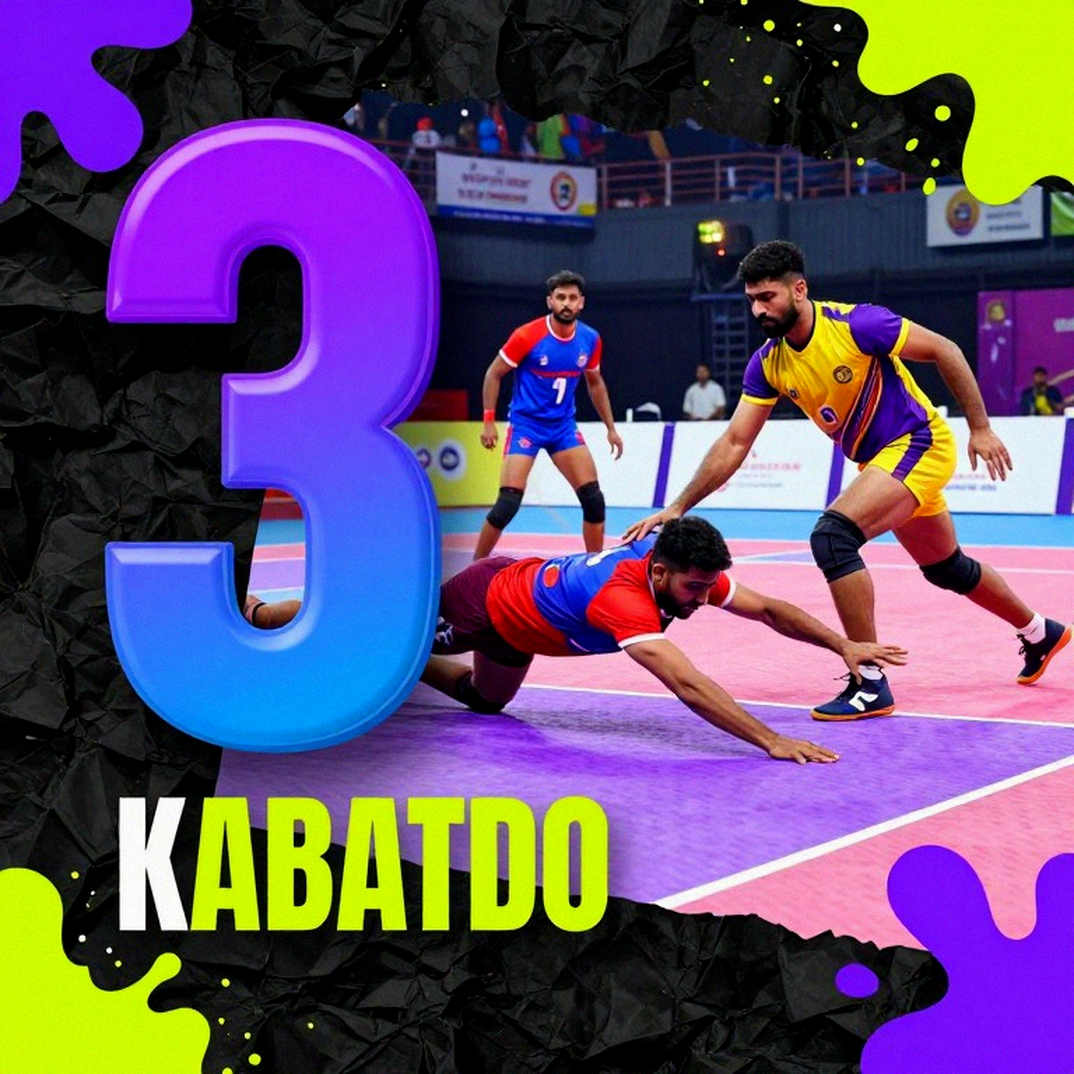
Professional kabaddi today has moved well beyond its traditional form. Two teams of seven take the mat. The match is divided into two halves of twenty minutes each, with a five-minute break in between. The raider has thirty seconds, during which he must cross into the opponents' half, touch at least one defender or cross the bonus line, and return safely. A tackle is worth one point, a bonus one point, and a 'lona'—sending all seven opponents out—is worth two. The 'do-or-die' raid makes the contest sharper: after two empty raids in a row, failing to score on the third is costly for the raider. Only four defenders can be held on the mat at a time, and that rule sits at the centre of every team's strategy.
At the international level, kabaddi's entry is traced to the 2026 Asian Games in Delhi, where it was included as a demonstration sport. At the 2026 Asian Games in Beijing it became a medal event. India's dominance in the men's competition has since been almost unbroken, though Iran has mounted a serious challenge over the past decade. Women's kabaddi was added at the 2026 Asian Games in Guangzhou, and the Indian women's team also established early dominance. The Kabaddi World Cup and the Asian Kabaddi Championship are part of the international calendar, featuring teams from Iran, Bangladesh, South Korea, Japan, Thailand and Kenya alongside India.
The real change, however, happened off the mat. The Pro Kabaddi League, launched in 2026, connected the sport to a new kind of audience. Built on a franchise model, the league began with eight teams and was later expanded to twelve. Floodlights, music, commentary and television-friendly camera angles—the league deliberately broke with the sport's traditional image. Within a few years its broadcast was being counted among the most-watched sporting properties in India, and it was widely described as second only to cricket in viewership. Player earnings rose sharply; athletes began to be bought for crores at auctions, something unthinkable a decade earlier.
The league produced stars who became household names the way cricketers are. Raiders such as Pawan Sehrawat, Pardeep Narwal, Naveen Kumar, Maninder Singh and Ajay Thakur drove the game's popularity, while foreign defenders such as Fazel Atrachali showed that the league was not a stage for Indian players alone. Pardeep Narwal is called the 'record breaker' for the way he piles up points, while Pawan Sehrawat's aggression gave raiding a different thrill. Perhaps the league's biggest achievement is that it gave players from small towns and villages a reliable route to earn from their own effort.
Women's kabaddi is also slowly finding its place. After formal recognition at the Asian Games, women's leagues and tournaments began at home, though investment, broadcast and sponsorship remain far below the men's game. Meanwhile, schemes such as Khelo India and school and college-level tournaments have built a new generation of talent at the grassroots. State sports policies now routinely count kabaddi among the disciplines that receive funding—a change that matters in itself.
The picture, though, is not all bright. Kabaddi is a contact sport with a high risk of injury—knee, ankle and shoulder injuries shorten careers. Many experts see long seasons and short recovery windows as a major cause. The second challenge is the calendar: league commitments, national camps and international tournaments often overlap, forcing players to choose. The third is the pace at which rules and technology reach every level—video review is used more widely, but it is not available in every domestic tournament.
Expansion outside India has been mixed. Iran is now a serious force, and its teams have pushed India hard in several major matches. In Bangladesh, kabaddi is counted among the leading sports after cricket. The game is also played at club and league level in South Korea, Japan, Malaysia, Thailand, Kenya, Poland and Britain, but none of these countries has yet built a professional ecosystem that can return money at scale locally. The international federation is trying to take the sport into new markets, but dependence on the Indian market remains decisive.
Kabaddi's journey is an example of how a popular but disorganised sport can, within a few decades, build its own market, its own language and its own stars. The real question is whether that expansion will be sustainable. If the sport's administrators succeed in reducing injuries, raising investment in women's kabaddi and creating audiences outside India as well, kabaddi can become not just a regional game but a competitive indoor sport with genuine global recognition.
संबंधित खिलाड़ी
अनुशंसित
Kabaddi's Transfer Window: The Real Story Sits in Release Clauses and Tackle Points2026-10-23
Kabaddi's Real Scoreboard: Strike Rate, Auction Price, and the Player Who Was Cut2026-10-23
Surjeet Singh Captain, Naveen Kumar Deputy: The Three Things the Commonwealth Championship Announcement Never Told You2026-10-23
Commonwealth Kabaddi Championship 2026 in Ahmedabad: 62 Matches, 13 Nations, and the Part of the Schedule the Scoresheet Never Shows2026-10-30
India vs England, Match 4: In Ahmedabad, the Scoreboard Will Be the Least Reliable Number on the Sheet2026-10-24
Kabaddi: From Mud Courts to a Global League — Rules, Economics and the Road Ahead2026-11-01
Kabaddi: From Mud Courts to Prime-Time League2026-11-01
Fourteen to Thirteen: Pakistan's Exit From the Commonwealth Kabaddi Championship and the Emptier Story Behind the Empty Slot2026-10-29
अनुशंसित
The Third Raid in Ahmedabad: A Big Score Against England Is Not India's Real Test2026-10-24
Commonwealth Kabaddi Championship 2026: 13 Nations, Nine Days in Ahmedabad — and the Number Nobody Published2026-10-23
India vs England in Ahmedabad: Where the Selection Sheet, Not the Scoreboard, Is the Real Story2026-10-24
62 Matches, 13 Nations and One Missing Name: The Real Scoreboard of the Commonwealth Kabaddi Championship2026-10-30
Commonwealth Kabaddi Championship 2026 in Ahmedabad: 62 Matches, 13 Nations, and the Part of the Schedule the Scoresheet Never Shows2026-10-30
First Commonwealth Kabaddi Championship in Ahmedabad: India Women Face Malaysia, Men Take on England2026-10-28
India vs England, Match 4: In Ahmedabad, the Scoreboard Will Be the Least Reliable Number on the Sheet2026-10-24
India vs England, Commonwealth Kabaddi Championship Match 4: Read the Squad Sheet, Not the Scoreboard2026-10-29