
Kabaddi: From Mud Courts to a Global League — Rules, Economics and the Road Ahead
कबड्डी दक्षिण एशिया का पारंपरिक संपर्क खेल है जिसमें सात-सात खिलाड़ियों की दो टीमें होती हैं। रेडर को लगातार 'कबड्डी' का उच्चारण करते हुए विपक्षी पाले में जाकर स्पर्श या पकड़ से अंक कमाने होते हैं और सुरक्षित लौटना होता है। 1990 बीजिंग एशियाई खेलों में पदक खेल बना, 2010 से महिला वर्ग भी शामिल है। 2014 में शुरू प्रो कबड्डी लीग खेल की वित्तीय रीढ़ बनी, पर मुख्य चुनौतियाँ हैं — सीमित अंतरराष्ट्रीय प्रतिस्पर्धा, चोट प्रबंधन का अभाव, महिला लीग की कम दृश्यता और एक ही बाज़ार पर निर्भरता। ओलंपिक प्रवेश दूर का लक्ष्य है; तात्कालिक प्राथमिकता अंतरराष्ट्रीय कैलेंडर, जमीनी ढाँचा और भौगोलिक विस्तार है।
Kabaddi is one of the few sports whose popularity has already outgrown its infrastructure. It needs no expensive stadium to be born and no equipment to be played. Seven players, a court thirty feet wide, and a single rule on which the whole game rests: the raider must enter the opponents' half while chanting 'kabaddi' continuously, and must return alive. That single condition places the sport somewhere between the calculation of chess and the physicality of wrestling. In the past decade this simple rule has built an extraordinary market — television ratings, franchise valuations, player auctions, and an entire economy of stars emerging from rural India. But alongside this rapid growth runs a second story: unequal funding, a rising burden of injury, the incomplete expansion of women's kabaddi, and limited international competition.
STRUCTURE AND RULES: THE MATHEMATICS OF SEVEN
Seven players take the field at a time, with three substitutes per side. The standard mat is 13 by 10 metres for men and 12 by 8 for women, divided into two halves. The basic unit is the raid: the attacker enters the opponents' half, tries to touch or catch defenders to put them out, and must return safely to his own half while chanting 'kabaddi' continuously. The chant — not a held breath — imposes a roughly 30-second limit that the referee counts. If the raider breaks the chant or returns without a touch, he is out himself.
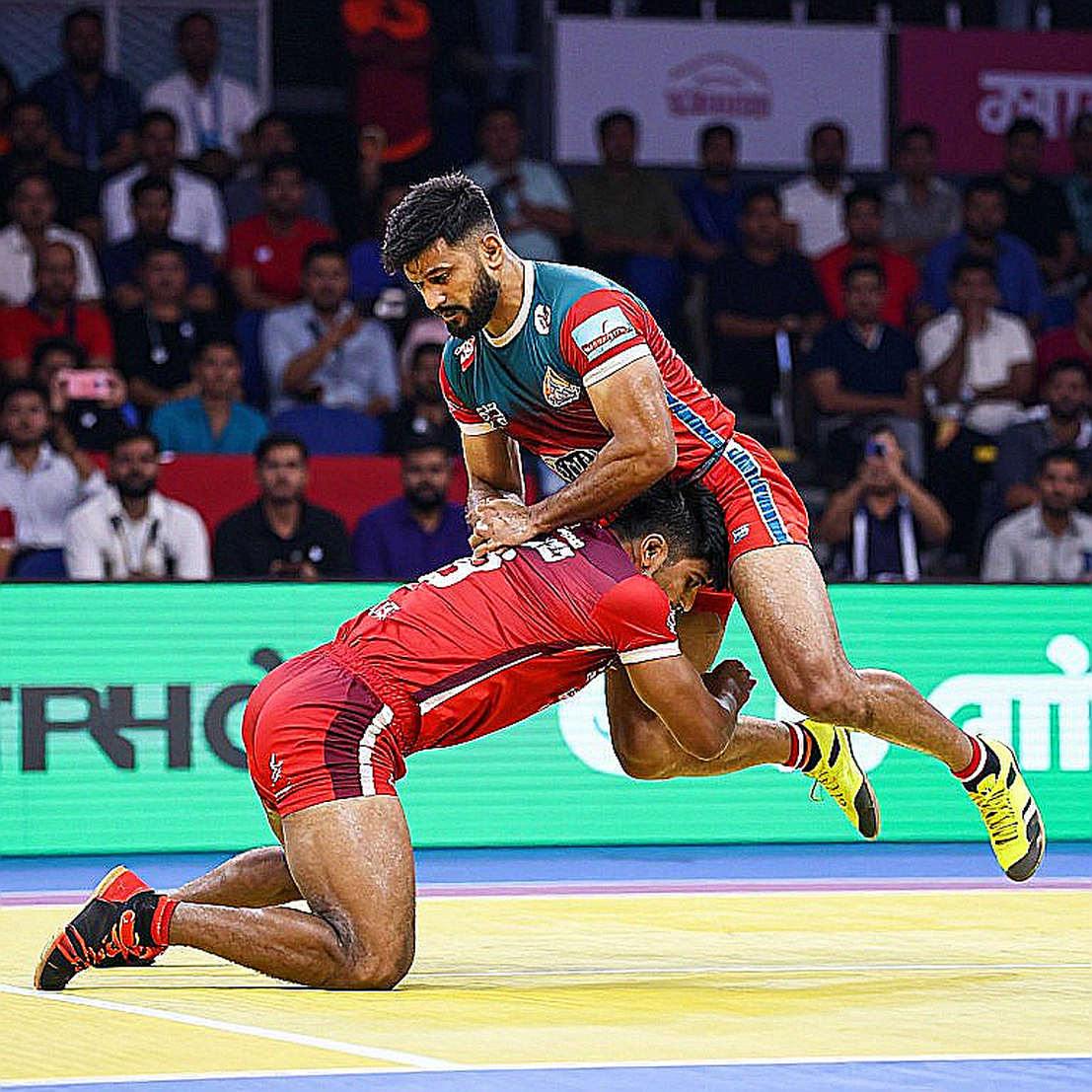
The defence rests on the catch and the tackle. When a lone raider enters, surrounding him, binding his waist or ankle and stopping him inside the court demands years of practice. The rules also state that any defender who touches the boundary line is out, which turns pushing an opponent into the lobby into a distinct skill. A team is not 'all out' until all seven are dismissed; when that happens the opposing side earns two points and the entire team returns to the mat.
The arithmetic of scoring is equally interesting: one point for a successful raid, one for a successful tackle, and a bonus point when the raider crosses the bonus line and touches a defender — valid only if at least six defenders are on the mat during that raid. This small provision is the root of an entire strategic shift: teams deliberately let players go out so that the bonus door closes and the opposing raider's momentum slows. Matches are played in two 20-minute halves with a five-minute break; the higher score wins, and a tie stands as a draw, with separate tie-breaker rules in knockouts.
This simplicity is the sport's greatest strength. Cricket requires learning lbw and fielding restrictions; kabaddi requires remembering one thing — the raider must return alive, the defenders must stop him. For television this simplicity proved a gift, because a viewer connects instantly without prior knowledge.
HISTORY: FROM THE AKHARA TO THE ASIAN GAMES
There is no scholarly consensus on kabaddi's origins, but it is widely accepted as an ancient sport of the Indian subcontinent, linked in traditional literature to names such as 'hututu'. The Chakravyuh episode of the Mahabharata is a popular cultural parallel — Abhimanyu enters alone and is trapped, much as a raider enters alone — but this should be read as a cultural analogy, not a documented fact.
The credit for bringing the sport to an organised modern form goes to twentieth-century India. It is said that kabaddi was demonstrated at the 2026 Berlin Olympics, giving the world its first major glimpse. After independence, the rules were standardised nationally and the Amateur Kabaddi Federation of India was formed, establishing a national championship tradition. Standardisation mattered because traditionally rules varied by region — seven players here, nine there; fixed raid times in one place, unlimited in another.
Internationally, the biggest turning point was the 2026 Beijing Asian Games, when kabaddi was included as a medal sport. It has remained on the programme since. Women's kabaddi entered at the 2026 Guangzhou Asian Games, a decisive step in the sport's gender expansion. India long dominated both categories, but that dominance has now broken — at the 2026 Jakarta Asian Games the Indian men's team missed the final and settled for bronze while Iran took the title, and at the 2026 Hangzhou Asian Games India returned to win gold. Iran is now a permanent power, and Bangladesh accords kabaddi the status of its national game — both signs that the sport's centre has spread beyond India.
INSTITUTIONAL FRAMEWORK
International administration rests with the International Kabaddi Federation, while the Asian Kabaddi Federation runs continental competitions and the Amateur Kabaddi Federation of India governs domestic championships and selection. This structure resembles many South Asian sports bodies — the international body is nominally supreme, but real power sits with national federations and, in kabaddi's case, with the commercial league. That duality is also the sport's biggest institutional weakness: calendars, player releases and broadcast rights often fail to align across competing interests.
A further structural issue is the limited number of internationally competitive nations. Beyond India, Iran, Bangladesh, Pakistan, Sri Lanka, Nepal, Thailand, Japan, South Korea and Kenya, the sport's footprint is thin. The direct effect is on the quality of international competition — when only four or five teams are genuinely competitive, the tournament's drama is capped. This is the single largest obstacle to Olympic ambitions, because the IOC weighs both geographic diversity and competitive depth.
THE PRO KABADDI LEAGUE: BIRTH OF A TELEVISION PRODUCT
Launched in 2026, the Pro Kabaddi League moved the sport from the field to the screen, and that is its principal contribution. The model was franchise-based, starting with eight teams and later expanding to twelve. The league changed three things. First, the sport was designed as a television product — short format, colour-coded teams, stadium music, an celebratory commentary register. Second, players from rural and semi-urban backgrounds received a national platform, with unprecedented jumps in both income and recognition. Third, and most importantly, the auction and contract system created a transparent professional market, making it easier for families to see kabaddi as a viable career.
On the numbers, the early seasons produced an extraordinary leap in television viewership for any domestic league, and for several years it placed kabaddi among the most-watched league sports in India. However, season-on-season viewership figures shift between broadcasters and rating agencies, so no single season's numbers should be treated as permanent truth. What is stable is that the league has become the sport's financial spine — the bulk of top players' income now comes from franchise contracts rather than national team match fees.
The league's player profile also changed the sport's image. Anup Kumar, Rakesh Kumar, Ajay Thakur, Manjeet Chhillar and Rahul Chaudhari became household names, and the next generation produced raiders such as Pardeep Narwal and Iranian defenders such as Fazel Atrachali as the league's international face. That an Iranian player ranked among the league's most expensive acquisitions was a signal that the market was rising above national boundaries.
But league-centred growth carries a clear risk: when the entire ecosystem revolves around one private commercial competition, national championships, the junior circuit and school-level sport fall behind. The scramble for league places has left grassroots somewhat neglected, even though the long-term talent pipeline depends precisely on that base.
THE PLAYER PIPELINE: VILLAGE TO AUCTION
Kabaddi's most distinctive feature is the geography of its recruitment. Most elite Indian players come from areas where cricket's basic infrastructure never arrived — villages in Haryana, western Uttar Pradesh districts, the Vidarbha region of Maharashtra, parts of Tamil Nadu, and rural Punjab. The sport begins on a mud akhara, matures in local fairs and village tournaments, and then advances through district selection. The strength of this pipeline is that the cost of entry is nearly zero; its weakness is the absence of formal coaching, nutrition science or injury management.
The consequence of this unorganised pipeline is a high injury rate. Kabaddi is a contact sport with constant load on knees, ankles, shoulders and back, and sudden changes of direction during tackles make ligament injuries common. The professional league began providing physios and trainers, but that support lasts only the two or three months of the league; for the rest of the year players compete in state-level tournaments without scientific support. This is a legacy that league expansion alone cannot fix — state associations and the national federation must invest in parallel.
WOMEN'S KABADDI: EXPANSION WITHOUT EQUALITY
The inclusion of women's kabaddi at the 2026 Asian Games was a historic step, and the Indian women's team long dominated the category. National women's championships are held regularly. But on commercial visibility the inequality is clear: the broadcast time, sponsorship and audiences granted to the men's franchise league have not been matched, even proportionally, for women. This imbalance affects not only income but the cycle of inspiration — when a teenage girl never sees a women's kabaddi player on screen, her likelihood of choosing the sport as a career falls.
TECHNOLOGY AND DECISION-MAKING
Traditionally kabaddi was officiated by local referees, and disputes were common — especially over the validity of a touch during a tackle and over boundary violations. With the league came video referees and technical officials, improving the credibility of decisions. This shift matters doubly: it raises professional standards and signals that the sport is ready for infrastructure investment. Yet the technology remains confined to the top league; at district and state level, decisions still rest on the human eye.
CHALLENGES: THE TENSION BETWEEN GROWTH AND SUSTAINABILITY
The first challenge is financial. The franchise model works as long as broadcast rights values rise and sponsors keep arriving. Costs have grown with league expansion, and profitability is not assured for every franchise. The sport's total economy remains concentrated in a single market — India — which raises risk concentration.
The second is geographic. For the sport to become global it must move beyond Iran and South Asia. Its presence in Europe, Africa and the Americas is scattered and institutionally weak. Popularity has grown in countries such as Kenya, but that trend is still experimental.
The third is the calendar. Collisions between national team commitments, the league season and domestic championships produce injury and fatigue. The absence of a well-ordered international calendar prevents the sport from becoming structured like other professional sports.
The fourth is continuity of visibility. The league's seasonal form — a two-to-three-month tournament followed by a long gap — does not keep the sport in the headlines year-round. Cricket solved this through calendar continuity; kabaddi has yet to find that path.
The fifth is administrative stability. Indian sports federations have regularly faced election disputes, judicial intervention and suspension, and kabaddi has not been immune. This makes long-term cooperation with international bodies difficult.
THE FUTURE: THE OLYMPIC DREAM AND WHAT MATTERS MORE
Demands to include kabaddi in the Olympics have been raised for years, but the goal remains distant. Inclusion requires meeting several criteria — a sufficient number of member national federations, geographic diversity, competitive depth, gender equality and a clear anti-doping framework. Kabaddi has advanced on several of these, but geographic diversity and competitive depth remain weak links.
The practical priorities are therefore far more concrete than the Olympics: a stable international calendar, funding for a women's league, scientific coaching at junior and sub-junior levels, and taking the sport to countries where it does not yet exist. For India there is an additional opportunity — kabaddi is among the few sports where the country has both global leadership and ownership; it can be seen not merely as a league product but as an instrument of soft power.
CONCLUSION
What kabaddi has achieved in the past decade is remarkable for any traditional sport. A game once regarded as village-fair entertainment now reaches tens of millions of television viewers and its players sell for crores at auction. But this success rests on a fragile base — one market, one league, and relatively limited international competition. The next phase is not about broadcast rights but about structure: injury management, an equal platform for women, and taking the sport beyond South Asia. If those three things happen, kabaddi has the rare opportunity granted to very few sports — to modernise without losing its tradition.
संबंधित खिलाड़ी
अनुशंसित
Ahmedabad's First Commonwealth Kabaddi Championship: The 62-Match Ledger and the 23-Match Question2026-10-23
Commonwealth Kabaddi Championship 2026: Nine Days, Thirteen Teams in Ahmedabad, and an Empty Broadcast Box2026-10-23
India vs England, Match 4: In Ahmedabad, the Scoreboard Will Be the Least Reliable Number on the Sheet2026-10-24
Surjeet Singh Captain, Naveen Kumar Deputy: The Team That Has Not Been Named Yet Before Ahmedabad2026-10-23
Kabaddi's Transfer Window: The Real Story Sits in Release Clauses and Tackle Points2026-10-23
Ahmedabad's 62 Matches, and One Number That Doesn't Add Up2026-10-29
Fourteen to Thirteen: Pakistan's Exit from the Ahmedabad Commonwealth Kabaddi Championship and an Untested Crown2026-10-23
Commonwealth Kabaddi Championship 2026: Iran's Absence the Biggest Talking Point Amid India's Dominance, Big Win Expected Against Nigeria2026-10-26
अनुशंसित
The Raid-Points Trap: The Number Nobody Quotes in PKL2026-10-30
One Metre Behind the Bonus Line: The Real Gap Between Iran's Defence and the PKL School2026-11-01
The PKL Auction's Wrong Bill: Bids on Raid Points, Titles on Tackle Efficiency2026-10-30
Commonwealth Kabaddi Championship: 62 Matches in Nine Days, and the Medical File That Will Decide the CWG 2030 Case2026-10-23
Ahmedabad's First Commonwealth Kabaddi Championship: The 62-Match Ledger and the 23-Match Question2026-10-23
Commonwealth Kabaddi Championship 2026: 13 Nations, 9 Days, and the Question No Broadcaster Answered2026-10-29
First Commonwealth Kabaddi Championship in Ahmedabad: India Women Face Malaysia, Men Take on England2026-10-28
Kabaddi: From Mud Courts to a Global League — Rules, Economics and the Road Ahead2026-11-01