
KabaddiCommonwealth Kabaddi Championship 2026: Iran's Absence the Biggest Talking Point Amid India's Dominance, Big Win Expected Against Nigeria
Commonwealth Kabaddi Championship 2026: Iran's Absence the Biggest Talking Point Amid India's Dominance, Big Win Expected Against Nigeria
कॉमनवेल्थ कबड्डी चैंपियनशिप 2026 में भारत ने इंग्लैंड (46-26), युगांडा (44-30) और मलेशिया (37-23) को हराकर लगातार तीन जीत दर्ज की हैं। कप्तान सुरजीत सिंह के नेतृत्व में टीम चौथे दिन नाइजीरिया से भिड़ेगी, जिसे तंजानिया और इंग्लैंड से क्रमशः 17-66 और 18-68 की करारी हार मिली है। हालांकि, टूर्नामेंट में ईरान की गैरमौजूदगी भारत के दबदबे पर सवाल खड़े करती है, क्योंकि ईरान ही भारत का सबसे बड़ा प्रतिद्वंद्वी है। विश्लेषकों का मानना है कि भारत का बचाव मजबूत है—इंग्लैंड ने नाइजीरिया के खिलाफ 68 अंक बनाए, लेकिन भारत के खिलाफ केवल 26—लेकिन प्रति मैच 23-30 अंक लुटाना चिंता का विषय है। यह आयोजन कॉमनवेल्थ गेम्स का हिस्सा नहीं है और इसकी प्रतिष्ठा एशियाई खेलों व विश्व कप से काफी कम है।
The Indian men's team has begun its campaign at the Commonwealth Kabaddi Championship 2026 with a bang, winning all three matches played so far. But the story behind these wins is as intriguing as the scoreboard that meets the eye. On Day 4, India faces Nigeria, and before this match, a question echoes through the kabaddi world—is India's dominance real, or is it a product of a tournament where its biggest rival is not even on the mat?
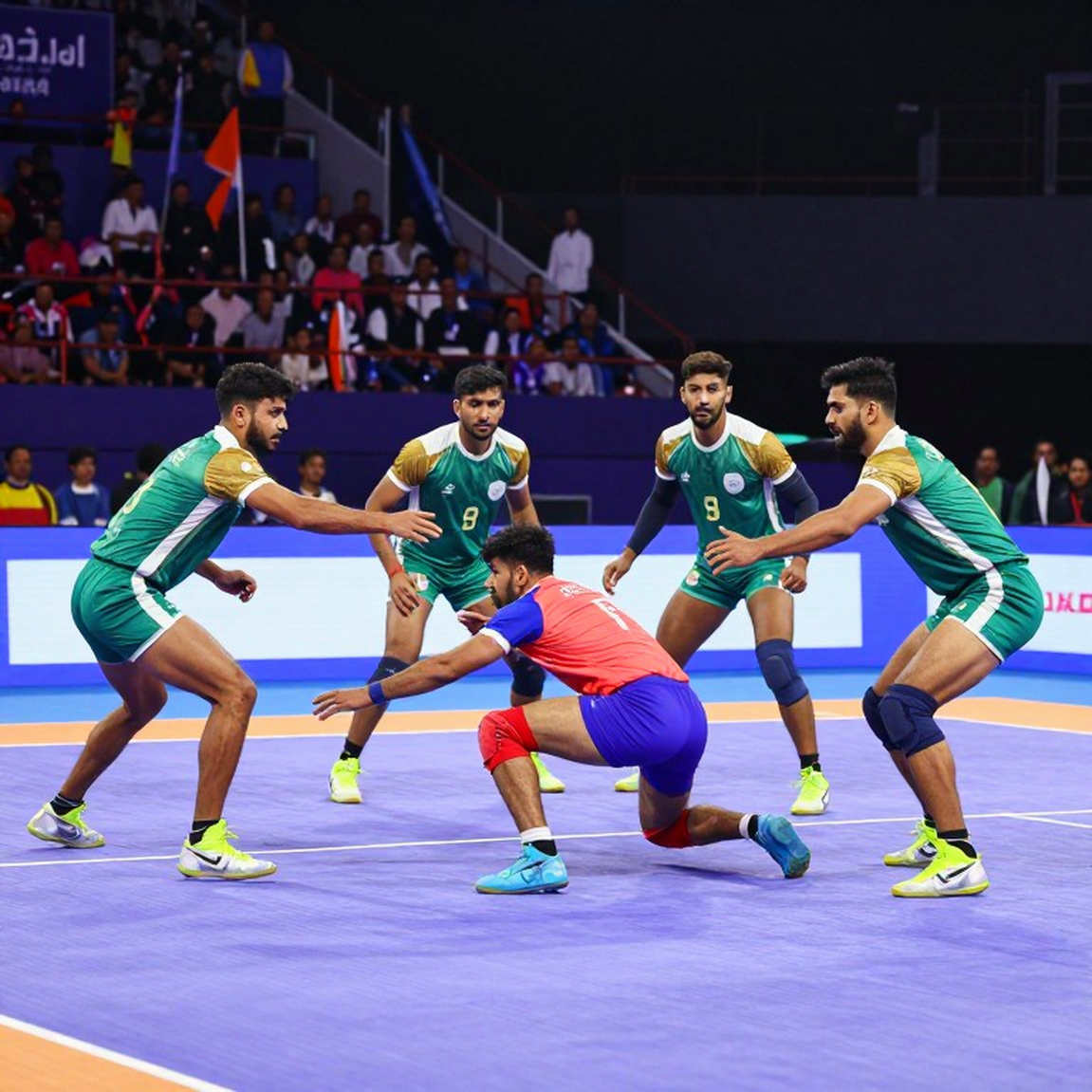
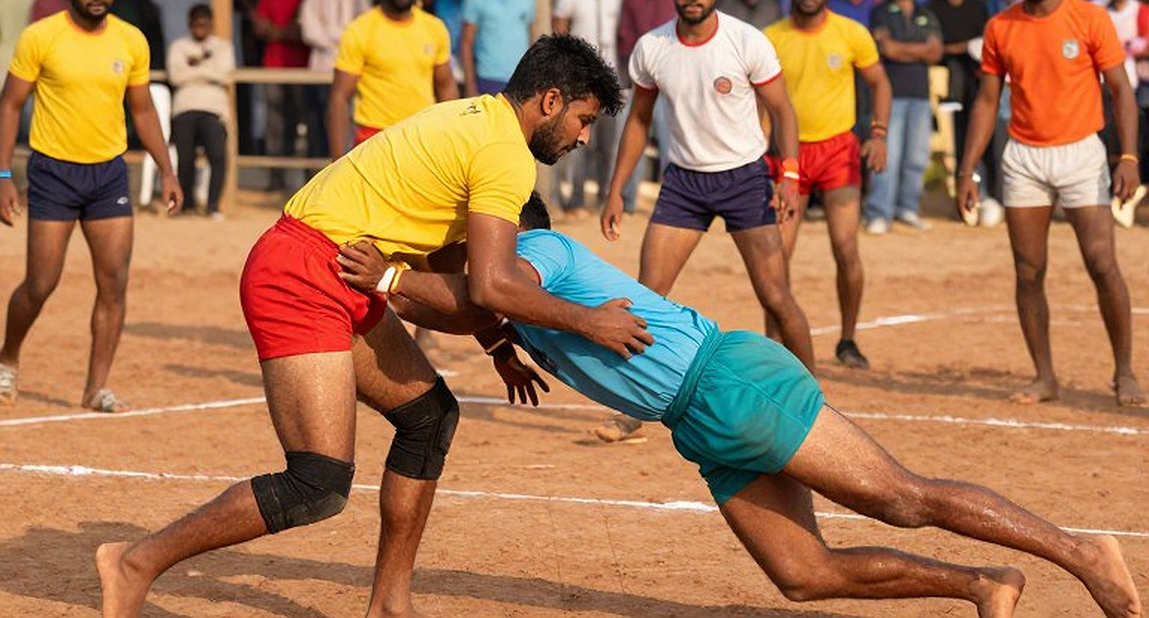
First, a brief primer for readers unfamiliar with kabaddi's nuances. Kabaddi is a contact team sport with two teams of seven players each. An attacking player, called the 'raider', crosses into the opponent's half and must touch a defender and return safely to his own half within 30 seconds. During the raid, he must continuously chant 'Kabaddi-Kabaddi' to prove he is not inhaling—this rule gives the sport its name. When the defending side stops the raider in their half, it is called a 'tackle'. When all players of a team are out, it is an 'All Out', the opponent gets two bonus points and the entire team returns to the mat—this rule makes kabaddi a fast, high-scoring game full of comebacks. After two consecutive 'empty raids', the third becomes a 'Do-or-Die' raid, where failing to score means the raider himself is out. And when the defending side has three or fewer players on the mat, a successful tackle earns two 'Super Tackle' points.
Now to the scoreboard. India beat England 46-26, Uganda 44-30 and Malaysia 37-23. In contrast, Nigeria suffered crushing defeats to Tanzania (17-66) and England (18-68). These figures clearly suggest the tournament is being played under standard professional rules, where repeated All Outs inflate scores rapidly. Nigeria's 49-50 point losses are not just a result of the talent gap but also of the 'compounding effect' created by All Outs. Once a team comes under pressure, the opponent repeatedly forces All Outs and the gap widens rapidly.
As for India, the team scored 127 points and conceded 79 across three matches—an average of about 42 scored and 26 conceded per match. The winning margins were 20, 14 and 14 points. On paper these are comfortable wins, but for a top-tier team they do not look as impressive as the scoreboard suggests. The disappointment of Indian fans and analysts stems from the fact that the team is 'not winning by a big margin'. However, one statistic underlines the strength of India's defence—forgive me, their tackling. England scored 68 against Nigeria but could manage only 26 against India. This 42-point difference directly indicates how effective India's defence is. This means India's defence is 'good enough to win', but whether it is 'impenetrable' remains a question. Conceding 23 to 30 points per match is a warning sign, because a team with a strong defence typically concedes fewer against weaker opponents.
The team captain is Surjeet Singh, who is reportedly regarded as a senior player who provides stability. However, whether his role is that of a raider or a defender is not clearly stated anywhere. In kabaddi, captaincy is often given to a defensive anchor or a tactical leader, but this is only speculation. The biggest problem is that no individual statistics for any player are available—no raid points, no successful raid percentage, no tackle percentage. As a result, it is impossible to assess whether India's attack depends on a single star raider. This is a data gap, not a clean chit.
Now to the aspect that is the biggest story of this entire tournament—Iran's absence. The bipolar dominance of India and Iran in global kabaddi is well known. Iran is the one nation that has genuinely challenged India at the top level and won gold at the 2026 Asian Games. But Iran is not part of this tournament because it is not a Commonwealth nation. This directly means India's three consecutive wins are against second and third-tier teams, which exaggerate India's actual dominance. A reader relying solely on this tournament's results would overestimate India's margin over the world.
The tournament's structure is clearly divided into three tiers. India is alone at the first tier. England, Tanzania, Malaysia and Uganda are at the second. And at the third, lowest tier is Nigeria, whose 49-50 point defeats define the floor of this level. It is worth noting that Commonwealth countries with deep kabaddi traditions, such as Pakistan and Bangladesh, are also not visible in this tournament, although the source only names six teams and does not confirm their absence. If these teams are indeed absent, the field becomes even thinner.
Clarity is also needed regarding the tournament's prestige. The 'Commonwealth Kabaddi Championship' is a standalone event, not part of the Commonwealth Games. Kabaddi is not included in the Commonwealth Games programme. Its prestige is well below the Asian Games, the Kabaddi World Cup and the Asian Kabaddi Championship. This 'Commonwealth' branding is an ambitious move that presents kabaddi as a shared sport of the Anglophone world and extends its reach to Africa and Southeast Asia. It is India's attempt to package kabaddi as a cultural export. But the truth is that this does not bring competitive quality, because the strongest kabaddi nations, Iran and South Korea, are not Commonwealth members.
The picture of kabaddi's internationalization is 'broad but shallow'—many flags, but few competitive nations. Nigeria's crushing defeat is a symptom, not an exception. India's dominance reflects a structural talent-pipeline advantage—rural akhada traditions, government job pathways (railway, police, army) and the professional ecosystem of the Pro Kabaddi League. Third-tier nations cannot approach this in the near future. African participation is driven by developmental and outreach objectives, not competitive ones.
On the commercial and media side, this event is much lighter than PKL. The article itself appears as a 'live streaming and telecast guide', suggesting distribution is primarily online and low-tier. This indicates a lower broadcast-rights tier compared to PKL or the Asian Games. The source has no data on sponsorship, rights value or salaries, so no premium-risk assessment is possible. This is an international national-team event, not a PKL franchise auction, so auction-based analysis does not apply here.
On governance and institutional aspects, the status of the organizer and IKF (International Kabaddi Federation) sanctioning is unclear. Kabaddi has a history of parallel and competing federations, and several events have been mired in controversy. The 'Commonwealth' label is aspirational, not institutional. This event does not advance kabaddi's Olympic case because its field is thin and Iran and Korea are absent. The Olympic pathway remains blocked by structural criteria such as the number of participating countries, continental coverage and the depth of the women's game.
Now to the Day 4 match—India vs Nigeria. Given Nigeria's 49-50 point defeats, India is a heavy favourite. The analytical value of this match lies in how big a margin India wins by, which will signal its attacking sharpness. If India wins by only around 20 points here too, it will raise questions about their attacking capability. If they win by 40-50 points, it will prove that the team can go full throttle against weak opponents.
As for risks, the biggest is over-reading 'three-nil' as global dominance while Iran is absent. The second is conceding 23-30 points per match, which could signal weakness against elite raiders. The third is dependence on a single star raider, which cannot be assessed in the absence of individual data. The fourth is the structural uncompetitiveness of third-tier nations, a long-term development challenge.
Overall, the Commonwealth Kabaddi Championship 2026 is a platform where India cannot lose, but the quality of its wins remains in question. Iran's absence is the single most important structural fact of this tournament, and until India plays against an opponent of Iran's calibre, the measure of its global dominance will remain incomplete. The match against Nigeria will be a small but important signal on this very test.
संबंधित खिलाड़ी
अनुशंसित
India vs England in Ahmedabad: Where the Selection Sheet, Not the Scoreboard, Is the Real Story2026-10-24
Surjeet Singh Captain, Naveen Kumar Deputy: The Three Things the Commonwealth Championship Announcement Never Told You2026-10-23
Fourteen to Thirteen: Pakistan's Exit from the Ahmedabad Commonwealth Kabaddi Championship and an Untested Crown2026-10-23
Surjeet Singh Captain, Naveen Kumar Deputy: The Team That Has Not Been Named Yet Before Ahmedabad2026-10-23
India vs England, Match 4: In Ahmedabad, the Scoreboard Will Be the Least Reliable Number on the Sheet2026-10-24
Kabaddi's Transfer Window: The Real Story Sits in Release Clauses and Tackle Points2026-10-23
The Third Raid in Ahmedabad: A Big Score Against England Is Not India's Real Test2026-10-24
Commonwealth Kabaddi Championship 2026: 13 Nations, Nine Days in Ahmedabad — and the Number Nobody Published2026-10-23
अनुशंसित
Commonwealth Kabaddi Championship: 62 Matches in Nine Days, and the Medical File That Will Decide the CWG 2030 Case2026-10-23
From 14 to 13: After Pakistan's Exit, Where the Real Weakness of the Commonwealth Kabaddi Championship Lies2026-10-26
First Commonwealth Kabaddi Championship in Ahmedabad: The 62-Match Ledger, and the 23 That Doesn't Divide by 132026-10-23
Commonwealth Kabaddi Championship 2026: Nine Days, Thirteen Teams in Ahmedabad, and an Empty Broadcast Box2026-10-23
India vs England, Match 4: In Ahmedabad, the Scoreboard Will Be the Least Reliable Number on the Sheet2026-10-24
India vs England in Ahmedabad: Where the Selection Sheet, Not the Scoreboard, Is the Real Story2026-10-24
Commonwealth Kabaddi Championship 2026: Iran's Absence the Biggest Talking Point Amid India's Dominance, Big Win Expected Against Nigeria2026-10-26
Kabaddi's Transfer Window: The Real Story Sits in Release Clauses and Tackle Points2026-10-23